Guide
Traces of the Maker: Craft and Display at Chatuchak
Materials, shapes, colors, and displays reveal traces of human choice at Chatuchak, where making, presenting, and selling still feel closely connected.
Looking Beyond the Finished Object
The first thing you notice when walking through Chatuchak Weekend Market is the sheer number of objects filling its stalls.
Brightly patterned textiles, wooden bowls in different shapes, small figures with visible stitches, tools and household items arranged across shelves. Each new stall presents another collection to explore, and it is easy to lose track of time simply looking at what is there.
But the appeal of Chatuchak is not limited to what is being sold.
Look a little more closely and other details begin to emerge: the choice of material, the differences between one form and another, the combination of colors, the way objects are hung from a wall or grouped on a shelf.
These details can suggest the decisions, attention, and time that exist behind a finished object.
The making process itself may not be visible. We may not know who created an item, where it was made, or which techniques were used. Even so, the surfaces, shapes, and displays can still carry a sense of human presence.
This time, rather than focusing on the kinds of products found at Chatuchak, we look at the smaller traces that remain around them.
Small Worlds Along the Aisle
At Chatuchak, the distance between the aisle and the stalls often feels remarkably small.
Objects are not always placed behind large windows or separated from visitors by carefully controlled displays. Textiles, baskets, wooden pieces, and small goods extend almost to the edge of the walkway.
Turn your head and you can see the texture of a material. Pause for a moment and your view may reach all the way to the back of a stall.
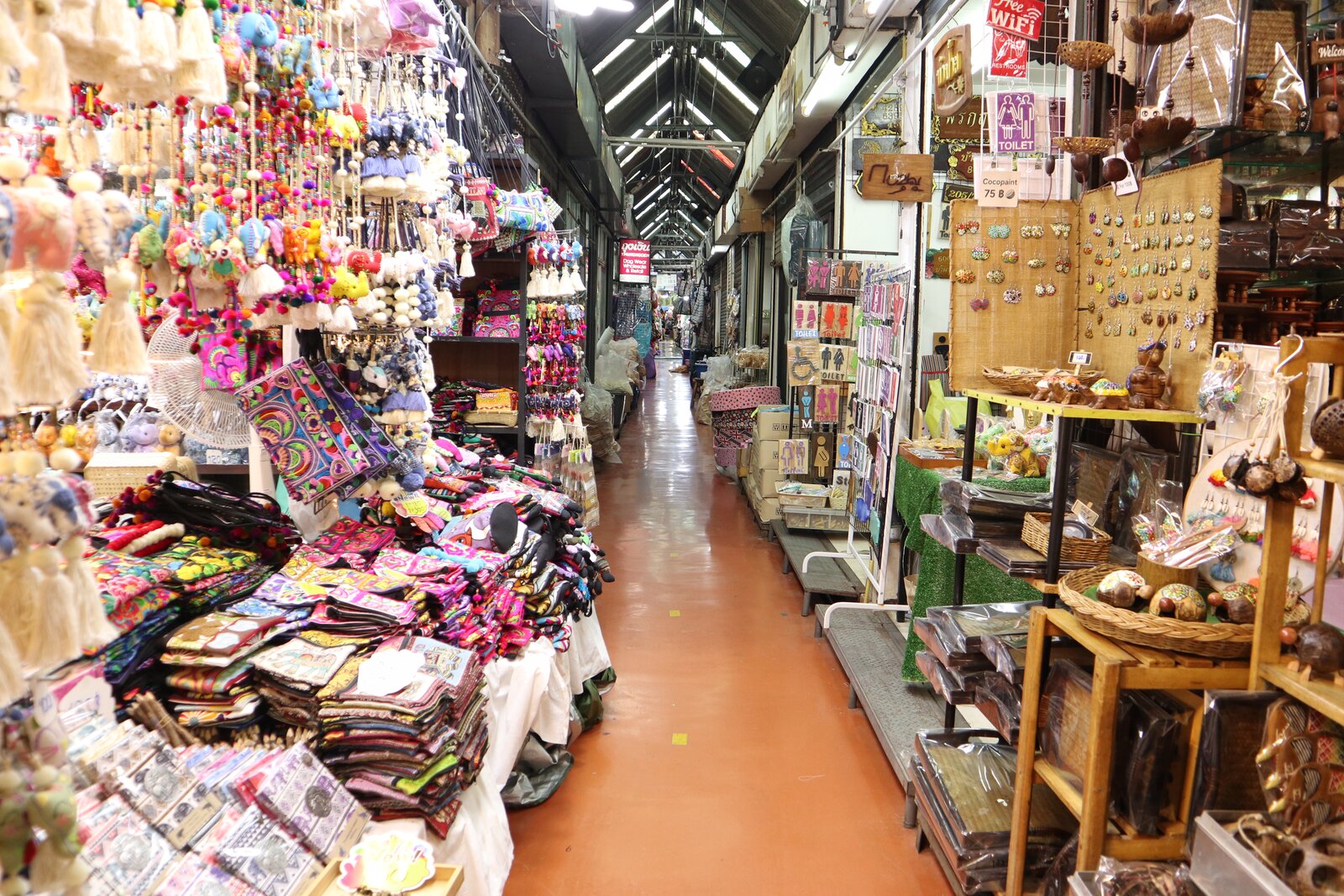
Along a narrow aisle, small stalls with very different personalities face one another.
Soft fabrics and colorful threads may appear on one side, while wood and more natural tones fill the other. Within only a few steps, the colors, textures, and atmosphere in front of you can change completely.
Here, walking and looking are not separate activities.
Moving through the aisle becomes part of the encounter with each material and form. Because the stalls open directly onto the path, the shelves, hanging displays, and depth of each space become part of the scene.
What remains in the memory is not only an individual object, but the small world that has been created around it.
Traces That Appear Up Close
From a distance, a group of objects may appear as a single colorful display. Moving closer reveals something different.
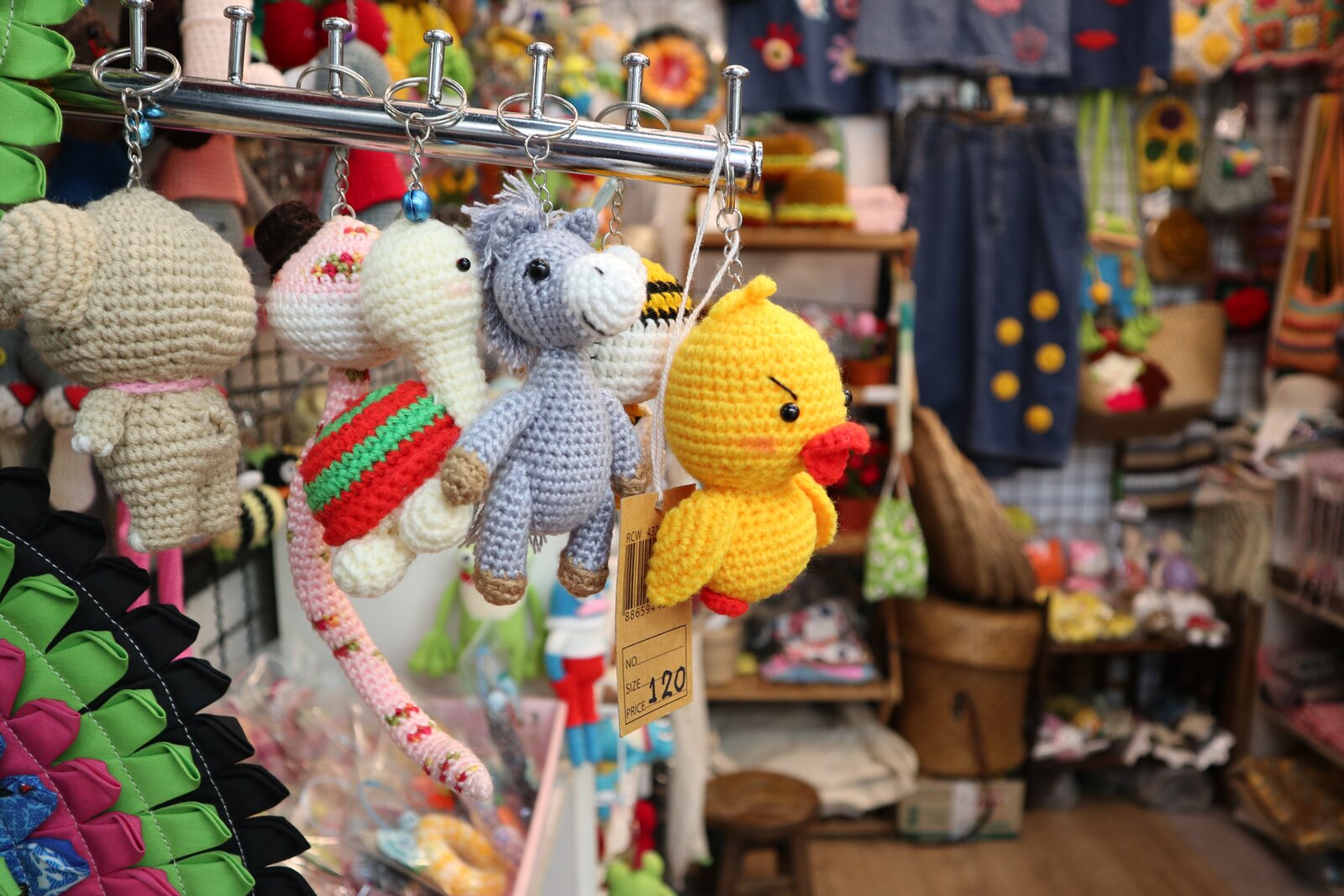
There are layers of thread forming individual stitches, slight differences in shape, and choices in how colors are combined. Looking at each hanging figure more carefully, it becomes possible to imagine the time and repeated movements involved in giving it form.
A photograph alone cannot tell us who made these objects, where they were produced, or exactly how they were created.
Still, when stitches, overlapping threads, and three-dimensional forms remain visible, the finished object can carry a certain warmth. It recalls the movement of hands without requiring us to invent a story about those hands.
These moments occur repeatedly throughout the market.
At first, a color or silhouette catches the eye. Then attention moves toward the surface, the seams, or the way one part joins another.
Instead of simply choosing an object, you begin to read it—slowly, through its details.
The Craft of Display
The character of a stall is shaped not only by the objects it contains.
What is placed at the front? Which shapes are grouped together? Are different sizes stacked, separated, or repeated? Are similar tones arranged in one area, or mixed to create contrast?
The act of displaying objects also reflects a series of choices.
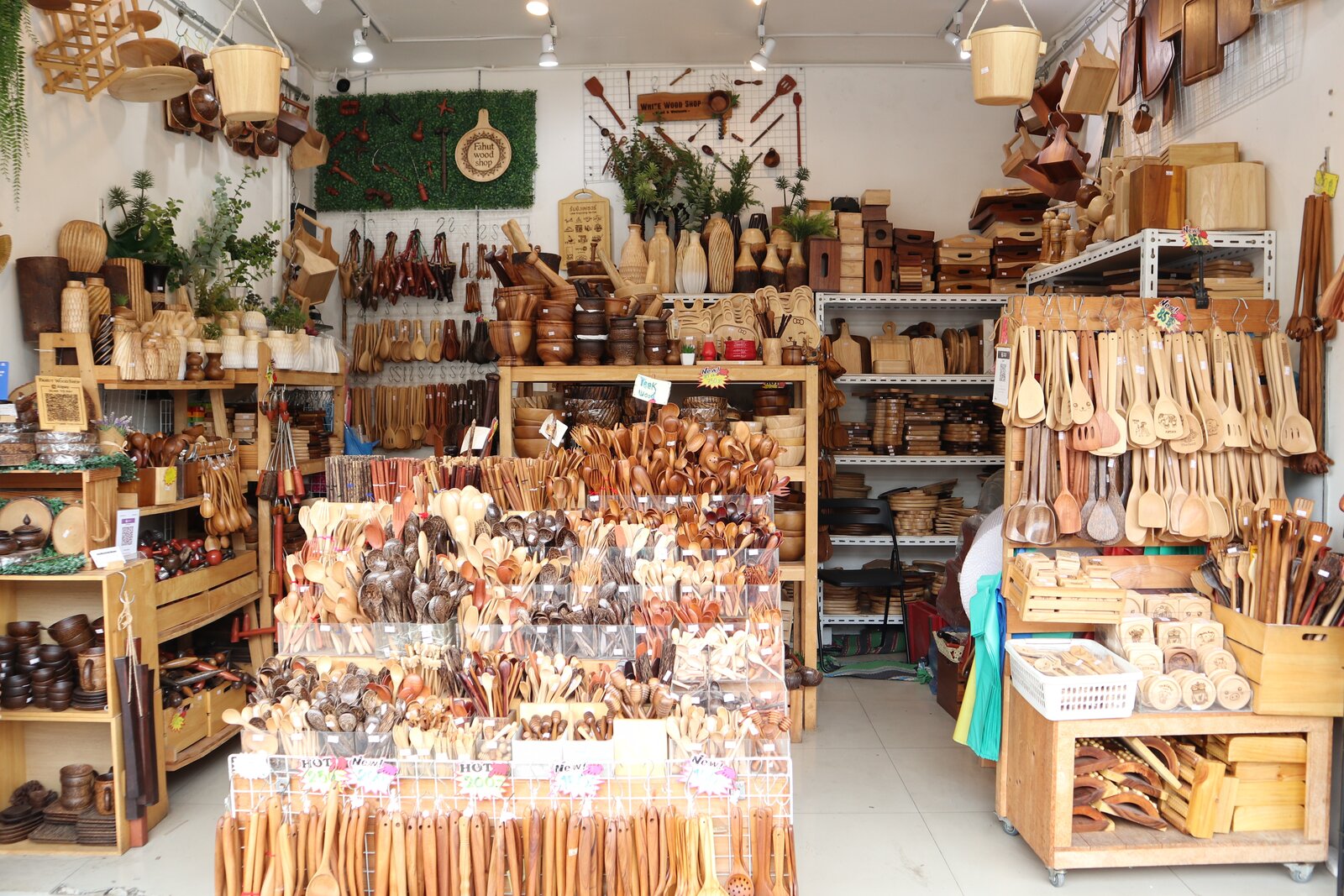
In a stall filled with wooden objects, the impression created by the whole space is different from the impression of any single item.
Bowls, spoons, boxes, boards, and other forms repeat across the shelves. They share related tones and textures, yet each varies in size, curve, and color. Together, these differences create rhythm across the stall.
Display is more than a practical way to store inventory.
It determines how one object is seen in relation to another, where the eye is drawn first, and what remains visible from the aisle. It shapes the experience of looking before anything is touched or purchased.
This is another kind of human presence within the market: not necessarily the hand that made the object, but the person who selected, arranged, and presented it.
How Materials Shape a Space
Not every stall at Chatuchak has the same density, color, or energy.
Some are filled almost edge to edge with objects, creating a lively sense of abundance. Others use more restrained colors and careful spacing to produce a quieter atmosphere.
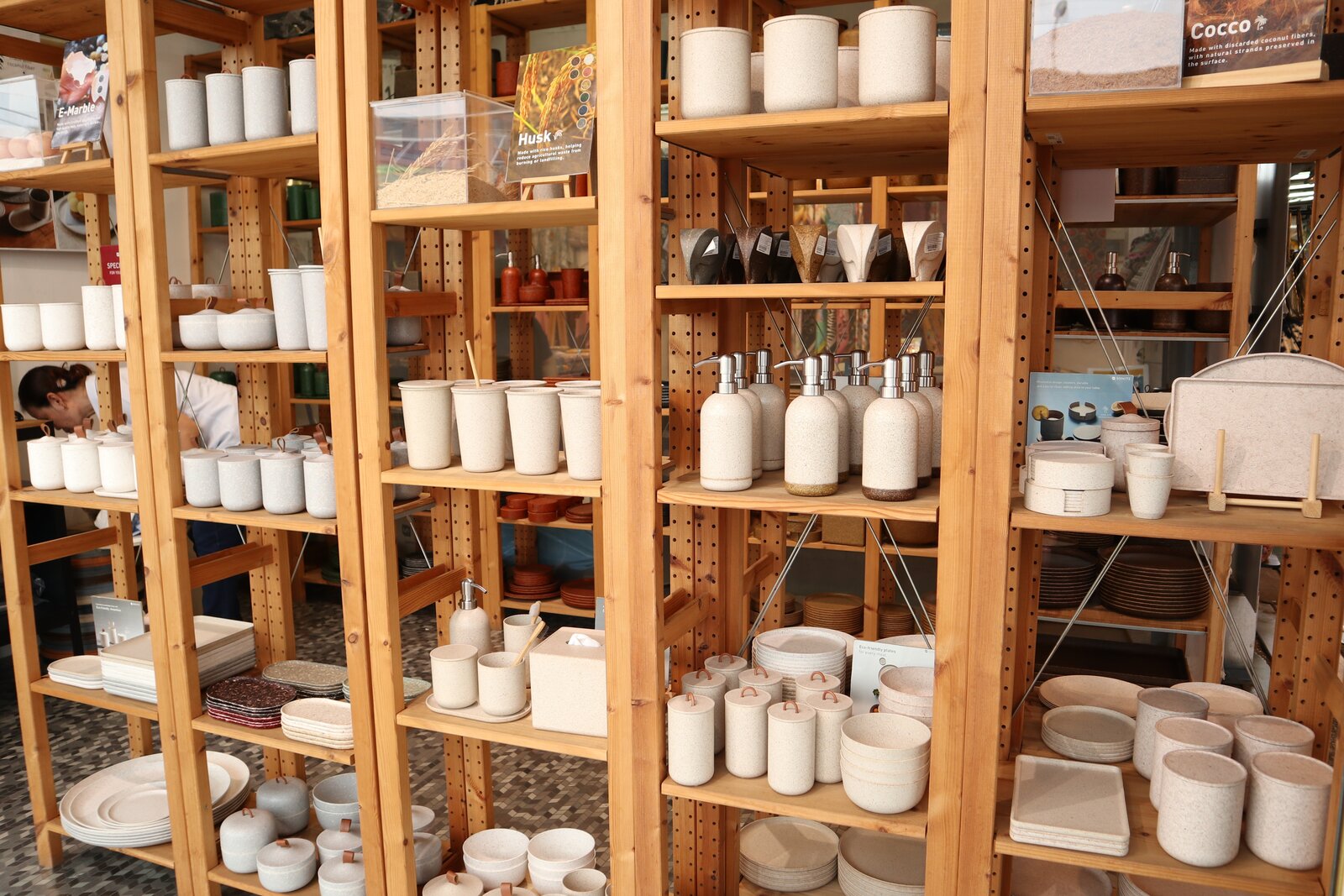
In this stall, pale objects are arranged against wooden shelves, creating a mood that feels distinct from the more densely packed displays nearby.
The vertical lines of the shelving, the limited color range, and the small spaces left between the objects all contribute to the character of the setting.
The photograph does not provide enough information to confirm the exact materials or manufacturing processes involved, and those details should not be assumed.
What can be seen, however, is how the display appears to respond to the objects themselves. Their surfaces, forms, and tones are presented in a way that allows them to be viewed as a group without losing their individual shapes.
When a material changes, the atmosphere surrounding it can change as well.
Looking at a stall is therefore not only about examining the objects. It is also about noticing how someone has chosen to introduce those objects to others.
Where Making Meets Selling
At Chatuchak, making, presenting, and selling can feel closely connected.
Objects, shelves, price tags, walls, lights, and aisles all remain within the same field of view. A finished item is rarely encountered in complete isolation. It is seen beside neighboring objects, within the depth of a stall, and among the movement of people passing through the market.
This setting changes the way an object is experienced.
Making and selling are not necessarily carried out by the same person, and the market should not be described as though every seller is also the maker.
Even so, in a small stall, decisions about what to select, how to arrange it, and who it may appeal to often remain visible in the space itself.
That closeness is part of Chatuchak’s appeal.
The story of an object does not appear to end when it is finished. It continues as the object is placed in a stall, noticed from an aisle, examined more closely, and perhaps carried away by someone new.
Becoming Part of This Market
Soi YIPUN also hopes to value this sense of closeness within Chatuchak.
The aim is to create a place where Japanese makers and small brands can do more than present their work from a distance. It is intended as a setting where their products can be introduced within the atmosphere of the market and encounter the responses of people visiting from Thailand and around the world.
Soi YIPUN is still in preparation and is not yet operating.
The planned location is in Chatuchak Weekend Market, Section 16, along Soi 23/4–5. Construction is currently expected to begin around September 2026.
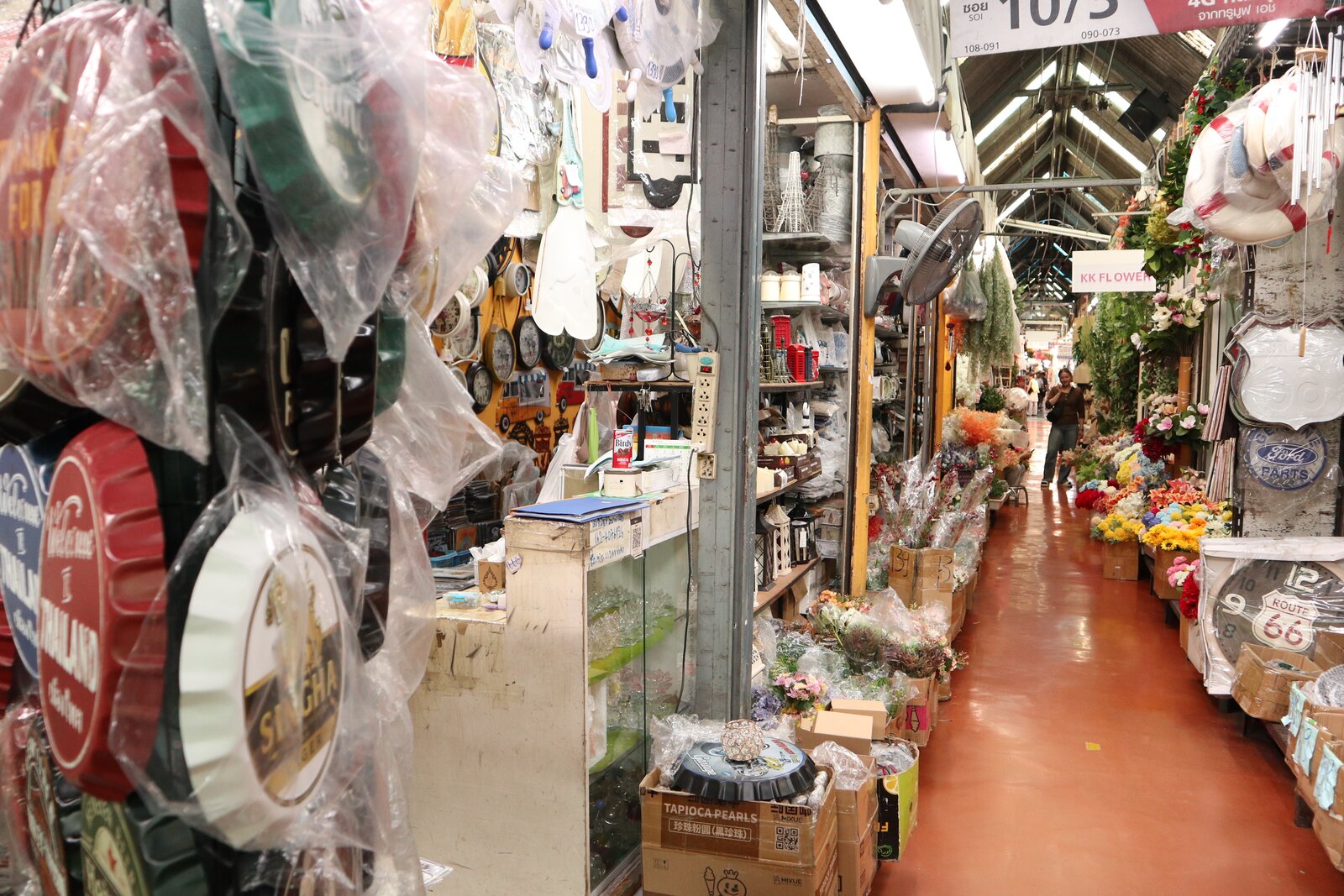
Beyond one aisle, another stall and another view continue further into the market.
What kinds of encounters might emerge when work from Japan becomes part of this landscape?
Soi YIPUN is preparing to create a small place where the distance between objects and people can become a little closer. Step by step, the project is moving toward the day when a new scene may become part of Chatuchak’s continuing streetscape.
Related Stories
If you’re drawn not only to the traces of handwork in materials and objects, but also to the small encounters that happen along the market’s lanes, see A Glance, a Pause: Small Encounters at Chatuchak.
If you are a Japanese maker interested in selling in Thailand, see For Creators & Brands.