Japanese Culture
Why Does a Daruma Always Rise Again? | A Japanese Symbol of Hope and Resilience
Explore the meaning of Daruma through their self-righting form, eye-painting custom and regional traditions, alongside hand-painted Shirakawa Daruma art.
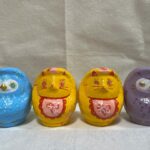
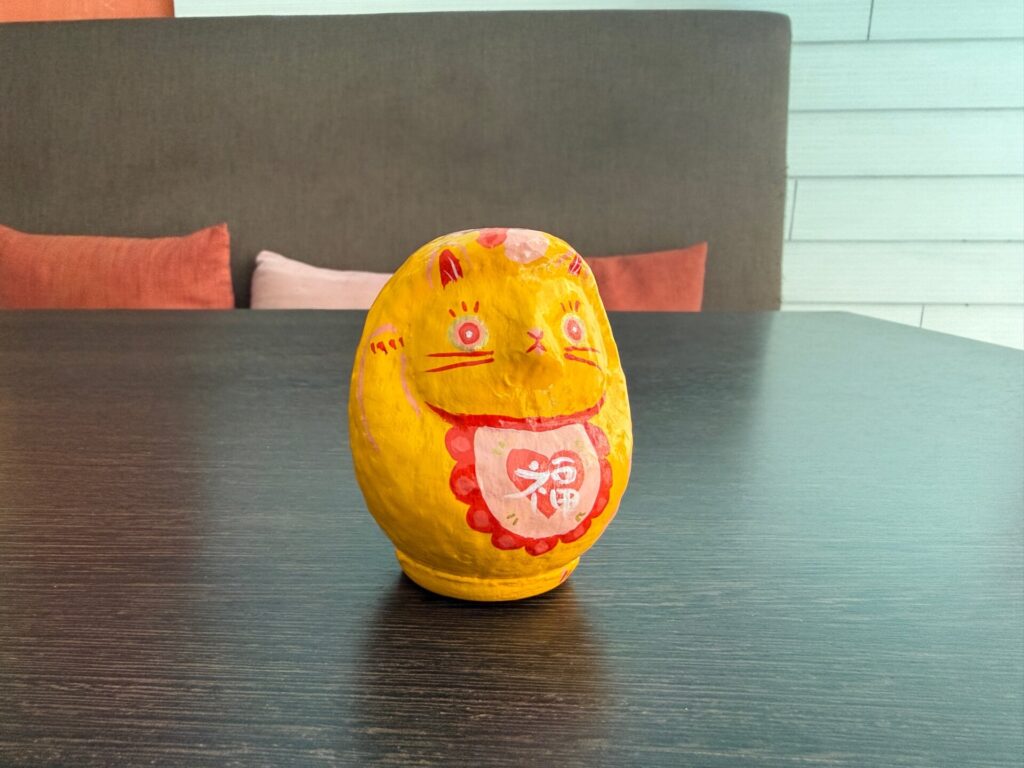
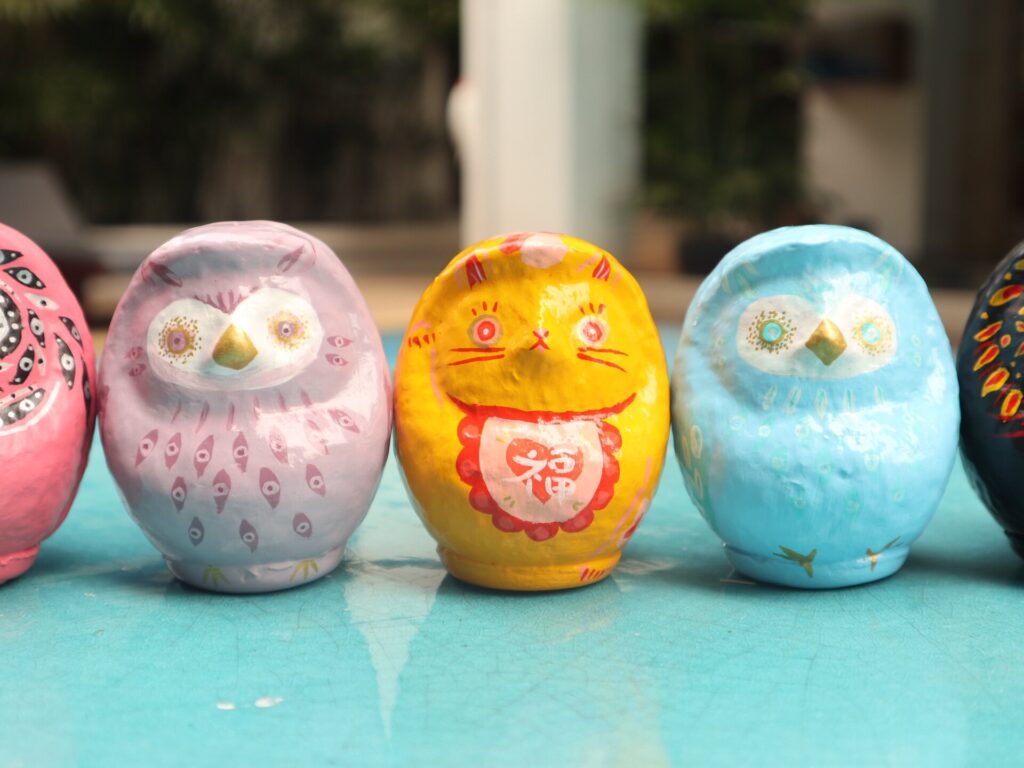
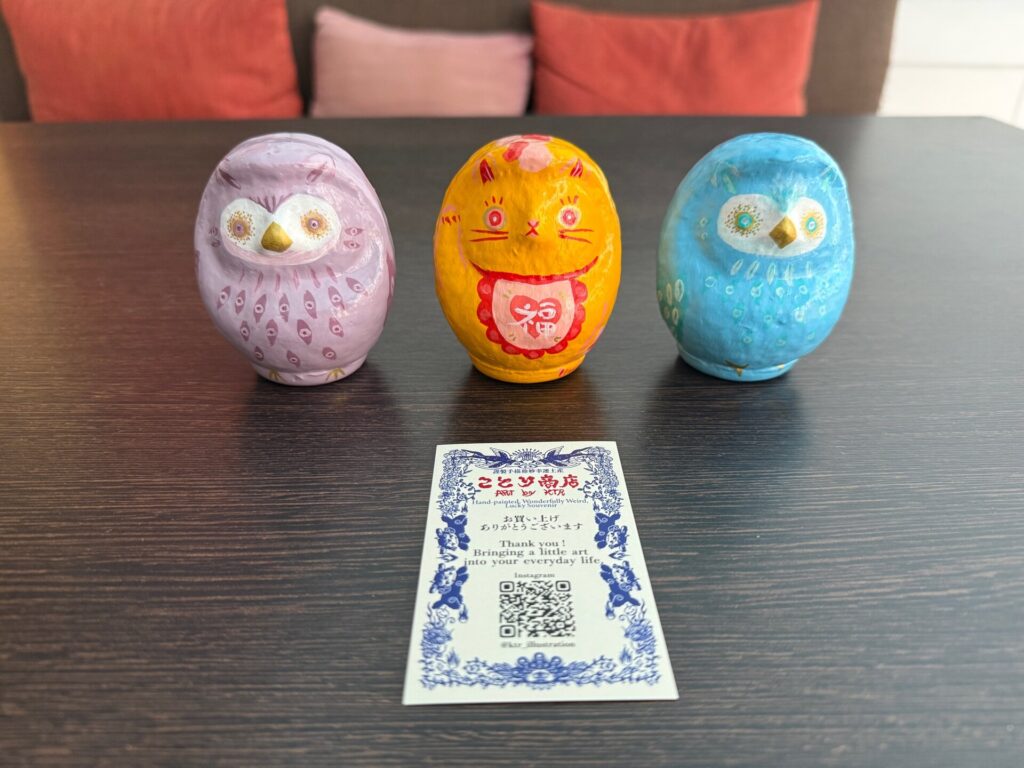
A blue owl, a purple owl, a yellow cat—and the Japanese character 福, meaning good fortune, painted across a small round body.
These hand-painted pieces, planned for sale at Soi YIPUN, begin with a form that has been familiar in Japan for generations: the Daruma.
They are created one at a time by Kotori, also known as KTR, the artist behind Kotori Shoten. Each work uses a Shirakawa Daruma made by Sagawa Daruma Seizosho in Shirakawa, Fukushima, as its base.
Although they share the same rounded form, no two expressions are exactly alike. Viewed up close, the uneven surface of the papier-mâché and the movement of the artist’s brush remain visible.
Why is a Daruma shaped this way? And how did this small figure become associated with wishes, perseverance and beginning again?
Starting with the artworks coming to Soi YIPUN, we look at the Japanese culture behind the Daruma.
Who Does a Daruma Represent?
The name Daruma comes from Bodhidharma, a monk known in Japan as Daruma Daishi.
Bodhidharma is traditionally remembered as a figure who travelled from India to China and helped shape the teachings that later developed into Chan Buddhism in China and Zen in Japan. In Japanese art, he has often been portrayed with an intense gaze, wrapped in a large robe.
One well-known story says that Bodhidharma spent nine years meditating while facing a wall. This should be understood as a legend passed down over time, rather than a fully verified historical event. The Metropolitan Museum of Art likewise describes the account of his nine-year meditation in a cave as a legend.
Another frequently repeated story says that his limbs disappeared after years of meditation. This, too, belongs to legend.
It is more accurate to understand the familiar Daruma form as the meeting of two ideas: artistic representations of Bodhidharma seated in meditation, and the construction of a rounded, self-righting figure.
A Shape That Returns Upright
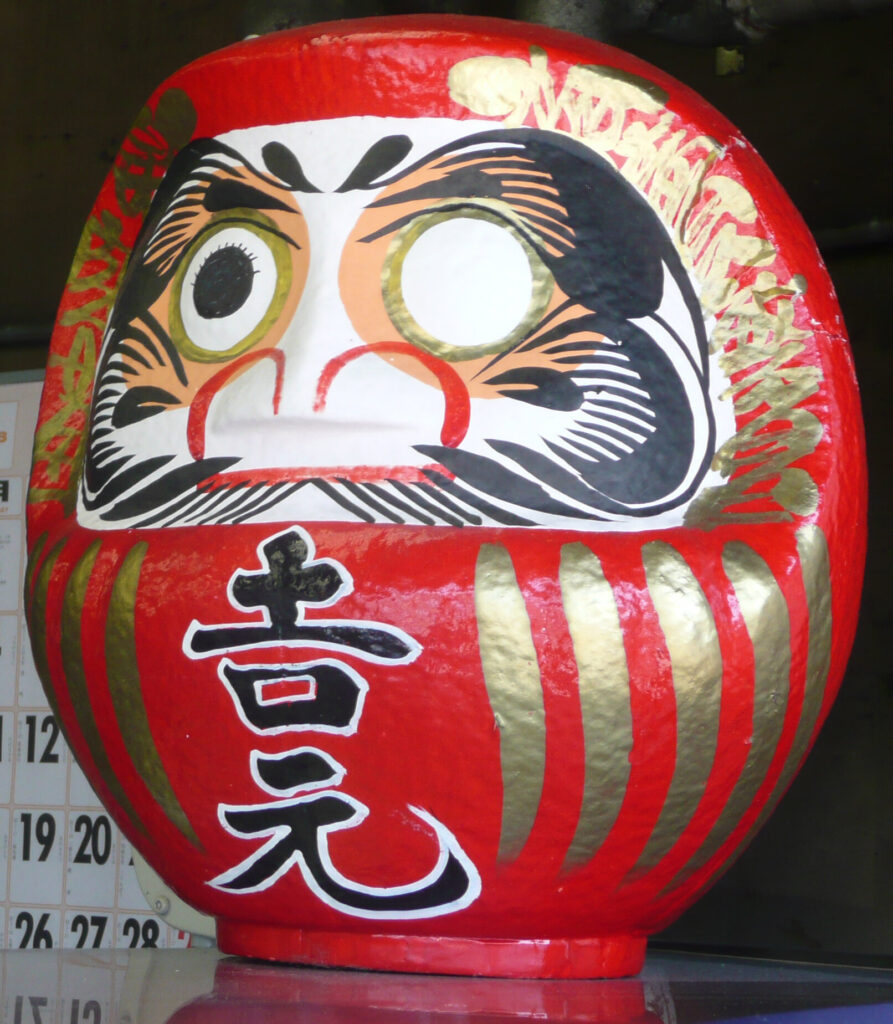
Many traditional Daruma are made using hariko, a Japanese papier-mâché technique.
Their rounded bodies are weighted toward the bottom. When pushed to one side, the low centre of gravity helps them return to an upright position.
This movement is often associated with the Japanese expression nanakorobi yaoki—“fall seven times, rise eight.”
The message is not that a person should never fall.
It is that setbacks do not have to be the end. When plans fail or circumstances change, it is still possible to regain one’s balance, adjust direction and begin again.
The hand-painted works coming to Soi YIPUN retain the rounded form and self-righting construction associated with Daruma. As each piece is individually painted, it is best enjoyed on display rather than rolled or repeatedly tipped, helping protect the artwork for years to come.
“Although each piece is made to right itself, I hope you will display it gently and care for it so the painted surface stays protected,” says Kotori/KTR.
Not a Device That Grants Wishes
In Japan, people have entrusted Daruma with many kinds of hopes: success in business, safety at home, passing an examination, completing a project or reaching a personal goal.
This does not mean that simply owning a Daruma guarantees that a wish will come true.
A Daruma can instead be understood as a visible reminder of a decision. Placed somewhere it can be seen each day, it brings a person back to the goal they chose and the actions needed to reach it.
In this sense, a Daruma does not predict the future. It stands quietly between a wish and the work required to pursue it.
A Promise That Begins with One Eye
Some Daruma intended for making wishes are sold without their pupils painted in.
A person paints in one eye when setting a goal or making a wish. The second eye may be added when the goal is reached, the wish is fulfilled, or a particular period has come to an end.
Official guidance in Shirakawa and Takasaki describes beginning with the Daruma’s left eye—the eye on the viewer’s right.
This is not, however, a universal rule for every Daruma in Japan.
The order and timing of painting the eyes vary by region, temple, household and type of Daruma. Some regional styles, including the Matsukawa Daruma of Sendai, are traditionally made with both eyes already painted.
Painting the first eye can mark a beginning. Completing the second can mark a moment of reflection. Between those two moments lies the action of the person who made the commitment.
The Kotori/KTR works introduced here are different. Their eyes are already part of the finished artwork, and they are not intended for the purchaser to complete through an eye-painting ritual.
Daruma Beyond Red
The most familiar image of a Daruma may be a round red figure, but Daruma made in different parts of Japan vary widely in their faces, colours, patterns, lettering and treatment of the eyes.
Takasaki Daruma from Gunma are known for eyebrows shaped like cranes and moustaches suggesting turtles. Many also carry characters such as 福入, meaning that good fortune has entered.
Matsukawa Daruma from Sendai are recognised by their deep blue colouring and decorative images of treasure ships and deities associated with good fortune.
Shirakawa Daruma from Fukushima have softly rounded forms and calm expressions. Their facial designs incorporate auspicious motifs including cranes, turtles, pine, bamboo and plum.
Today, Daruma can be found in white, blue, yellow, gold and many other colours. However, colour meanings are not governed by one ancient system shared across all of Japan. Interpretations can differ by region, maker and seller.
The character 福, read fuku in Japanese, expresses ideas such as good fortune, happiness and blessing. Characters including 福, 寿, 必勝 and 商売繁盛 make hopes visible through words: good fortune, longevity, certain victory and prosperity in business.
An Inherited Form, Reimagined by Hand
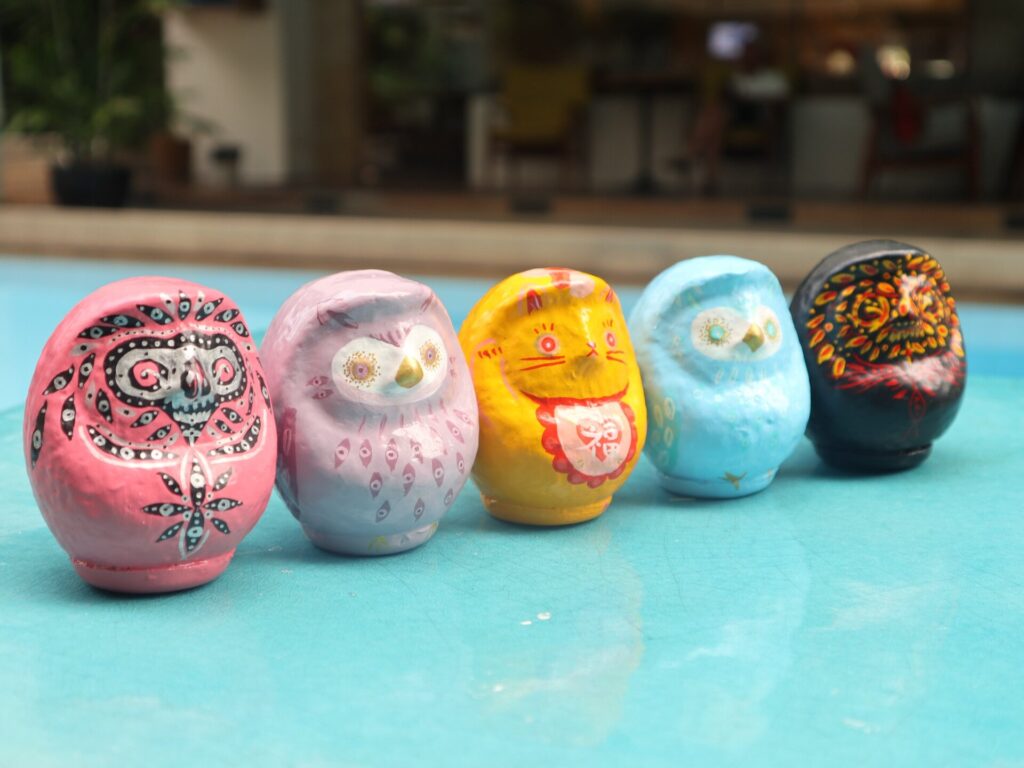
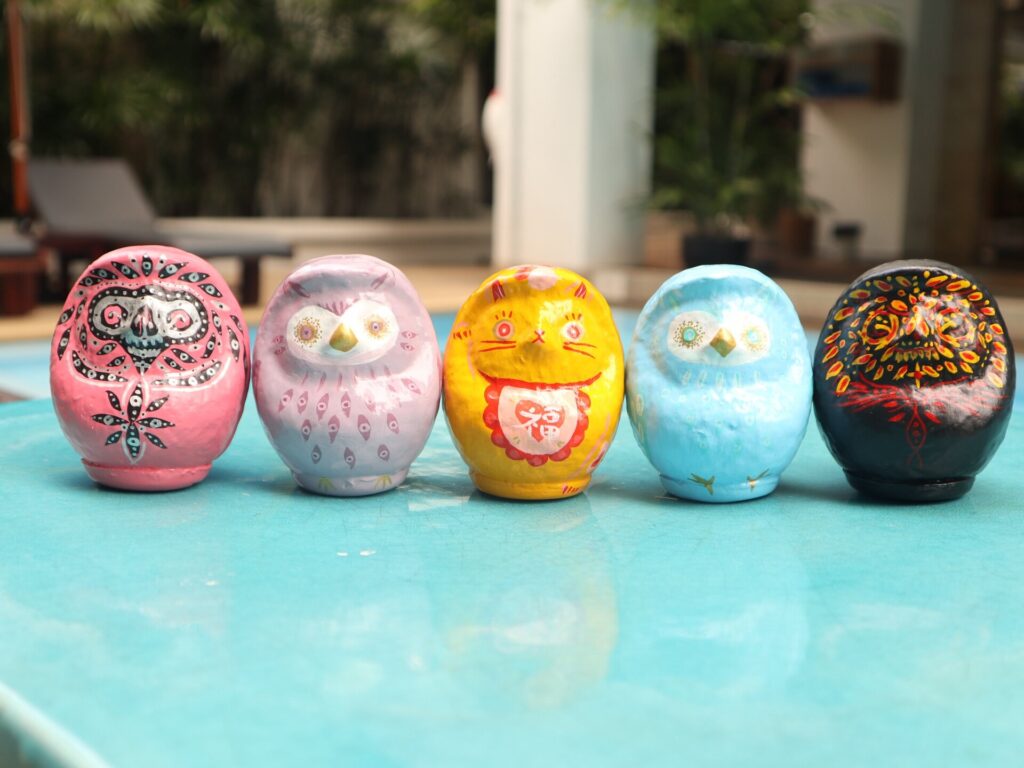
The Daruma painted by Kotori/KTR have colours and expressions far removed from the conventional red figure.
There are owls in pale purple and blue, a bright yellow cat, and intricate works in pink and black filled with eyes, feathers and organic patterns.
The lines are not mechanically identical. Small variations in the papier-mâché surface meet the movement of the brush, giving every piece a distinct presence.
These works are not traditional wish-making Daruma awaiting their final eye. They are completed art objects, painted in full by the artist.
Yet beneath every image is the rounded form that generations of Japanese makers have carried forward.
Tradition does not survive only by remaining unchanged. It can also continue when an inherited form meets a new artist and takes on the colours and imagination of the present.
Shirakawa itself holds exhibitions and open calls for “Shirakawa Art Daruma,” inviting people to add new painting and decoration to the city’s traditional craft.
Meeting a Small Daruma in Bangkok
One person may be drawn to the blue owl. Another may smile at the yellow cat. Someone else may pause over the many small eyes and carefully painted patterns.
There is no single correct way to respond to a Daruma.
It may remind someone of resilience and starting again. It may open a door to Japanese craftsmanship. Or it may simply be the colour and expression that makes a person stop.
Hand-painted Daruma artworks by Kotori Shoten and Kotori/KTR are planned for sale at Soi YIPUN, now preparing to open at Chatuchak Weekend Market, Section 16, Soi 23/4–5 in Bangkok.
At the shop, visitors will be able to see details that photographs cannot fully convey: the texture of the papier-mâché, the traces of the brush and the expression that makes each piece different.
Sources and Further Reading
- The Metropolitan Museum of Art, “Portrait of Daruma”
- Takasaki City, history of Takasaki Daruma
- Takasaki City, about Takasaki Daruma
- Shirakawa City, Shirakawa Daruma and local specialty products
- Japan Heritage Portal (Agency for Cultural Affairs), Sendai hariko and Matsukawa Daruma
- Shirakawa City, “Shirakawa Art Daruma 2026”
- Web Japan, “Daruma Fair”
- Wikimedia Commons, “Daruma Doll.jpg”
Related content
Featured brands